Press.
The release, the ten App Store plates at full size, the icon and the facts. All of it may be used with coverage of Ariadne; credit Jake Scott Studio. Review codes on request from studio, at this domain.
Ariadne puts a light meter, false colour on film, ARRI look files and AR blocking on the iPhone Pro
A T-stop meter that holds to a third of a stop against an incident meter, false colour read off a film stock at its box speed, ARRI look files imported with no round trip through the Reference Tool, and AR blocking with lighting-grade stand-ins at true height. Underneath sit the viewfinder at real sensor modes, the lens catalogue and the sun path. Built by a working cinematographer for the iPhone Pro; one purchase, no subscription.
LONDON, September 2026. Jake Scott Studio today released Ariadne, an iPhone Pro app that does four things a director's viewfinder app does not: it meters the light to about a third of a stop, it reads false colour off a film stock, it imports ARRI look files directly, and it blocks the scene in AR with lighting-grade stand-ins at true height. It also has what a scout expects: the viewfinder at real sensor modes, the lens catalogue and the sun path. A working cinematographer built it, and it is on the App Store now at £99.99 and $99.99 as a single purchase.
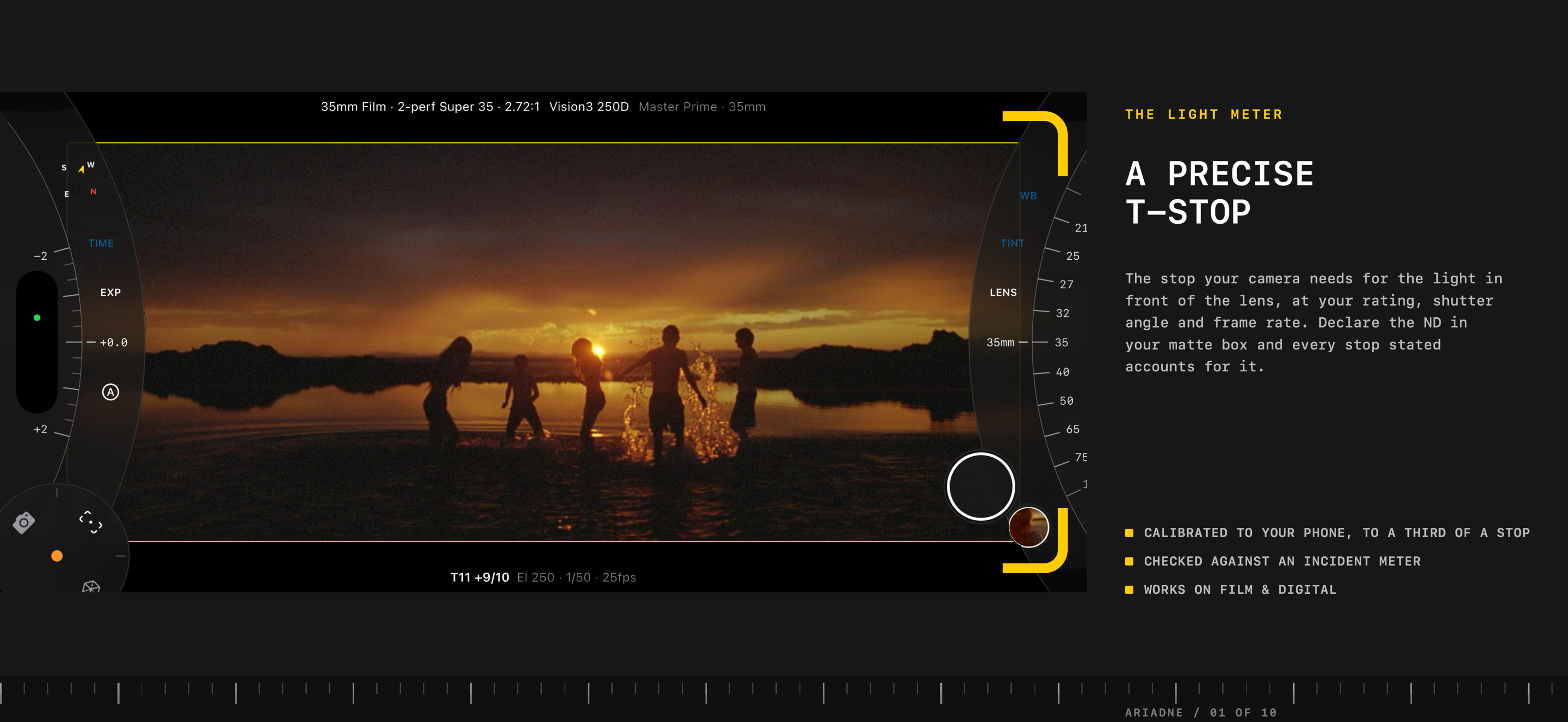
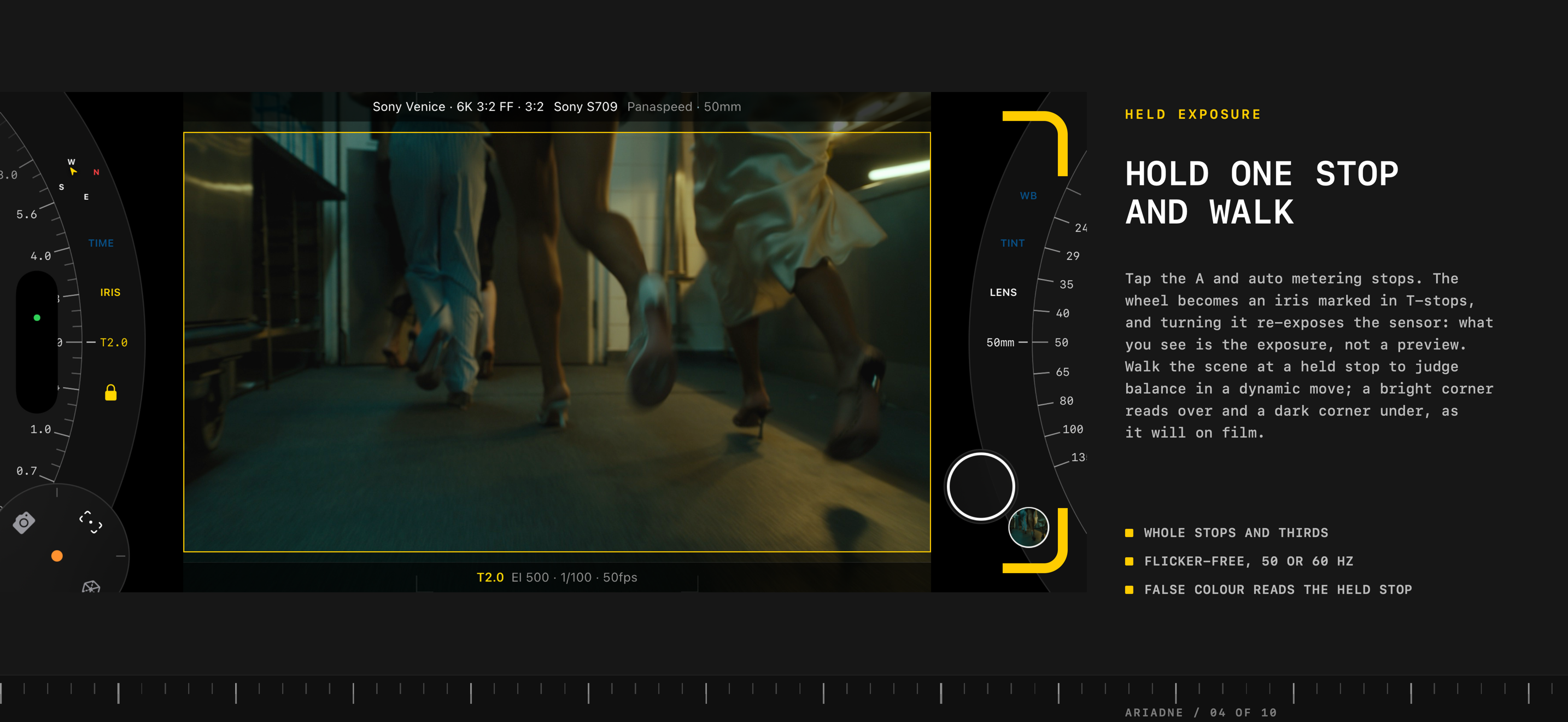
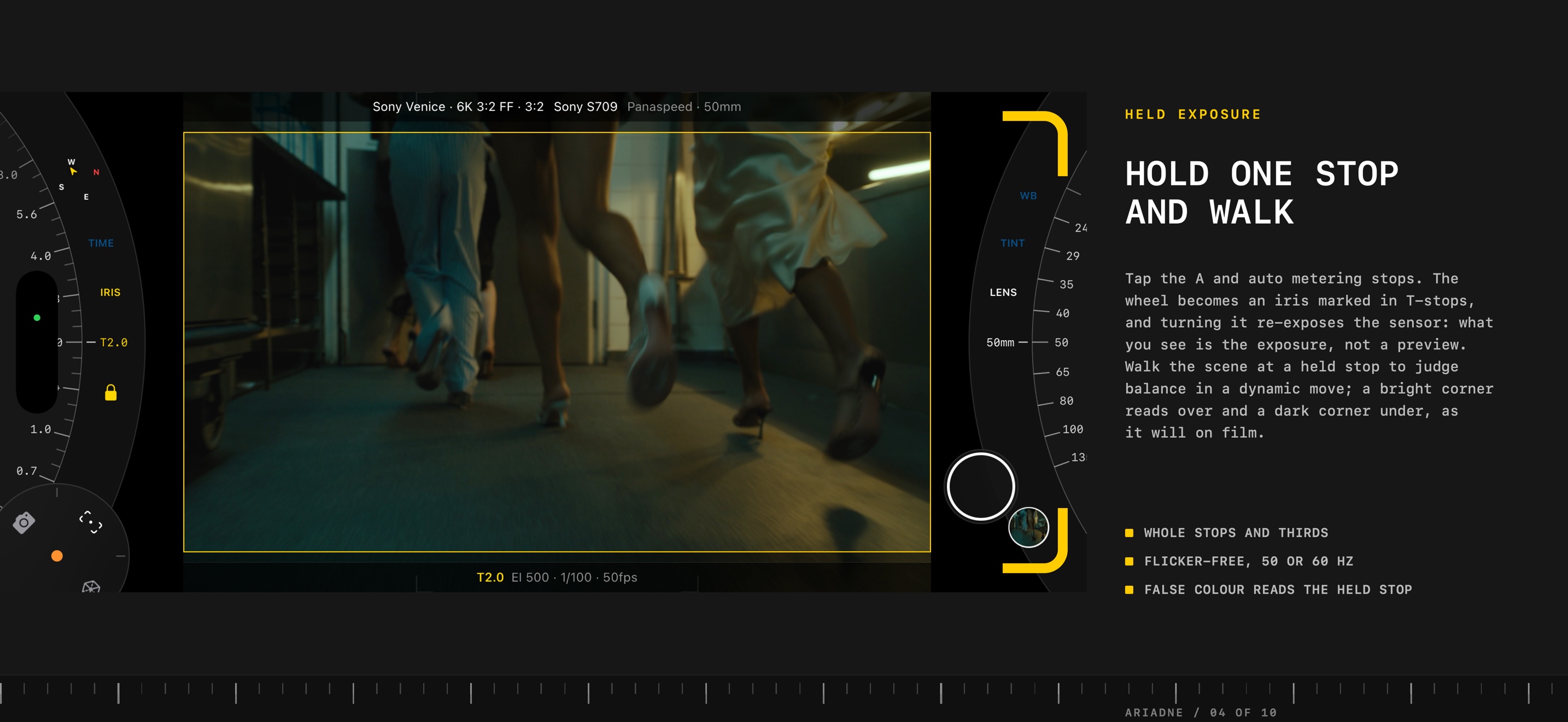
A band beneath the picture shows a live T-stop for the light in front of the lens, at the selected rating, shutter angle and frame rate. Declare the ND in the matte box and every stop accounts for it. The reading is tested against an incident meter and holds to about a third of a stop, and it can be calibrated against your own meter. Hold the exposure and the control wheel becomes an iris ring marked in real T-stops that re-exposes the sensor, so a location can be walked at one stop the way it is walked on film: a bright room reads over, a dark corner under.
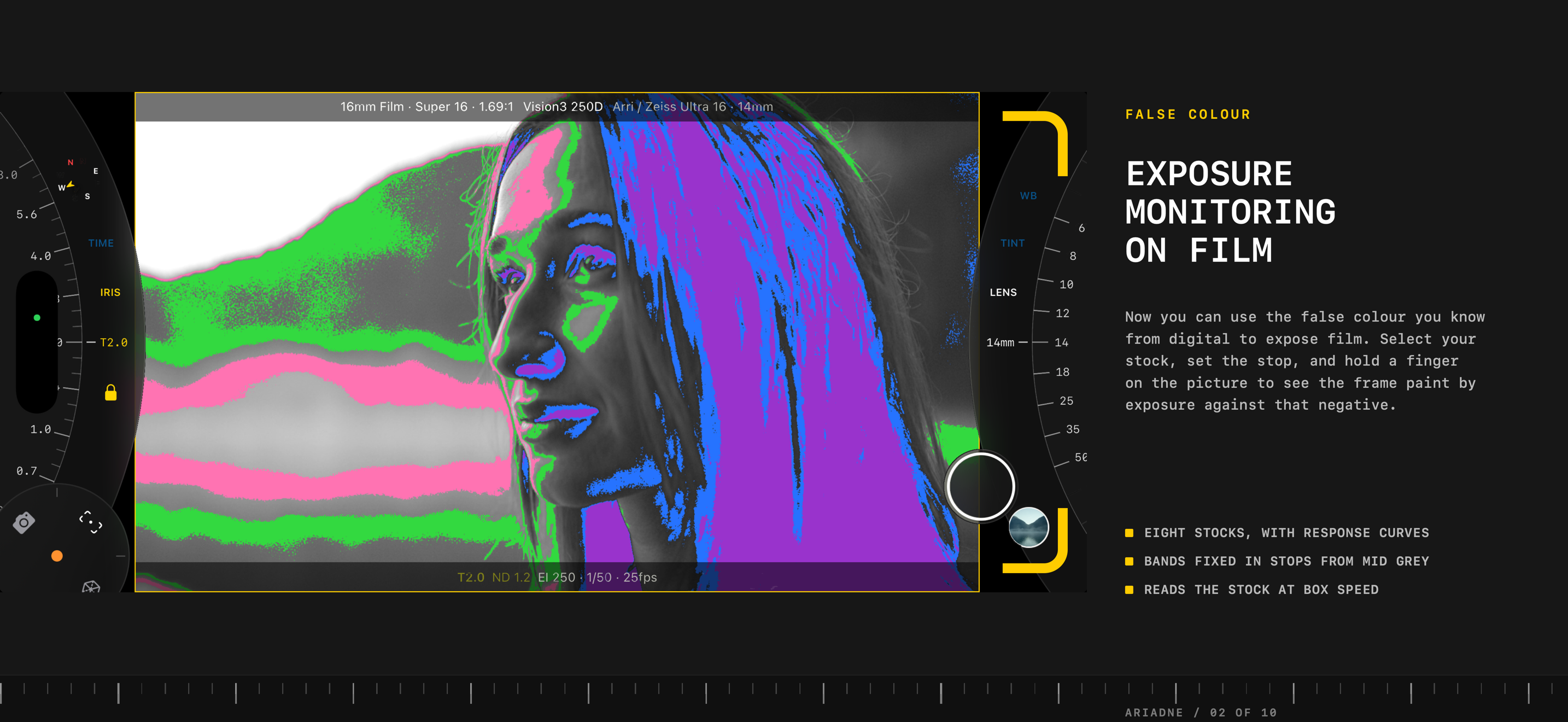
A film camera has no waveform and no false colour, so there is no way to see what the negative is doing. Ariadne gives it false colour. On a film body, touch and hold the picture and the frame paints by exposure in stops from mid grey, read against the selected stock at its box speed. Roll the exposure wheel until the bands sit where you expect across a face, and the band states the T-stop to set on the lens. The scale has no over-exposure colour, on purpose: the phone's sensor clips several stops before a negative does, and a red band would report the phone's limit as the shot's. It does let you establish where your mid-tones and shadows are, and keep a mental picture of your lighting contrast as you move through a shoot.
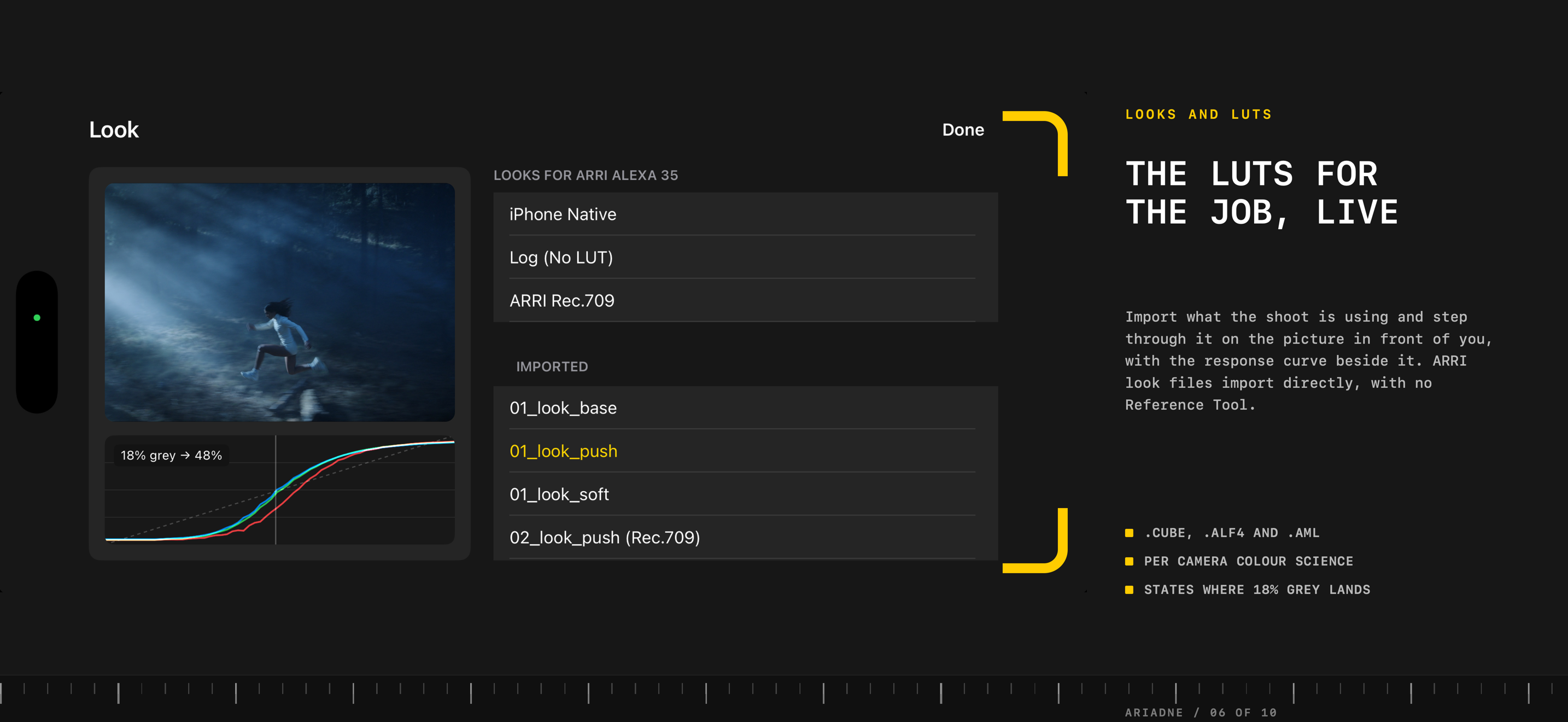
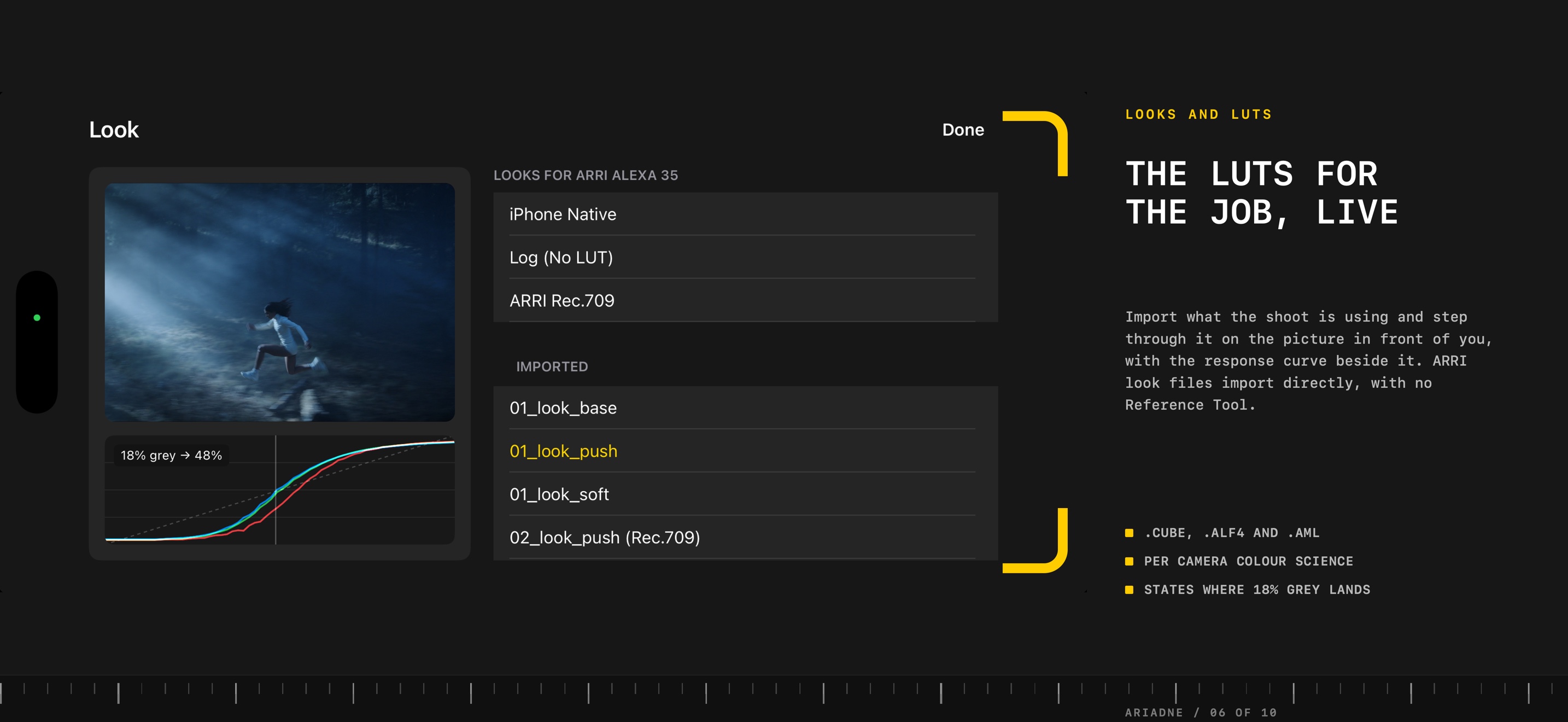
The Look sheet imports ARRI Look Files in .alf4 and .aml directly, alongside .cube, so the looks a job is using can be seen on the location itself with no round trip through the ARRI Reference Tool. Each look is rendered in the colour science it was authored for and shown beside its response curve, with a stated figure for where 18% grey lands. Eight film stocks, Vision3 50D, 250D, 200T and 500T, Verita 200D, Vision 320T, Ektachrome 100D and Double-X, are built from the manufacturers' published data; negatives are shown as lab-corrected prints, reversals uncorrected, keeping the cast of the light.
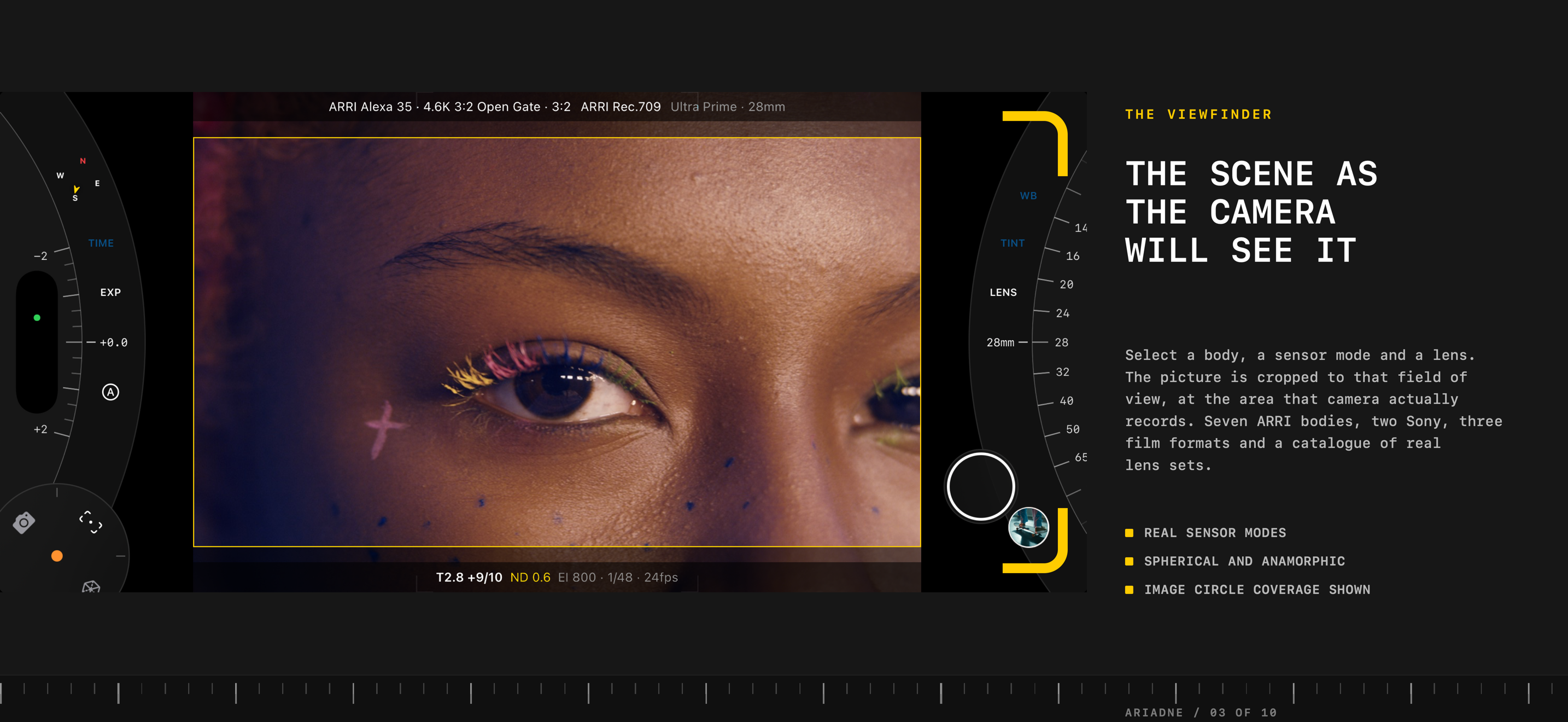
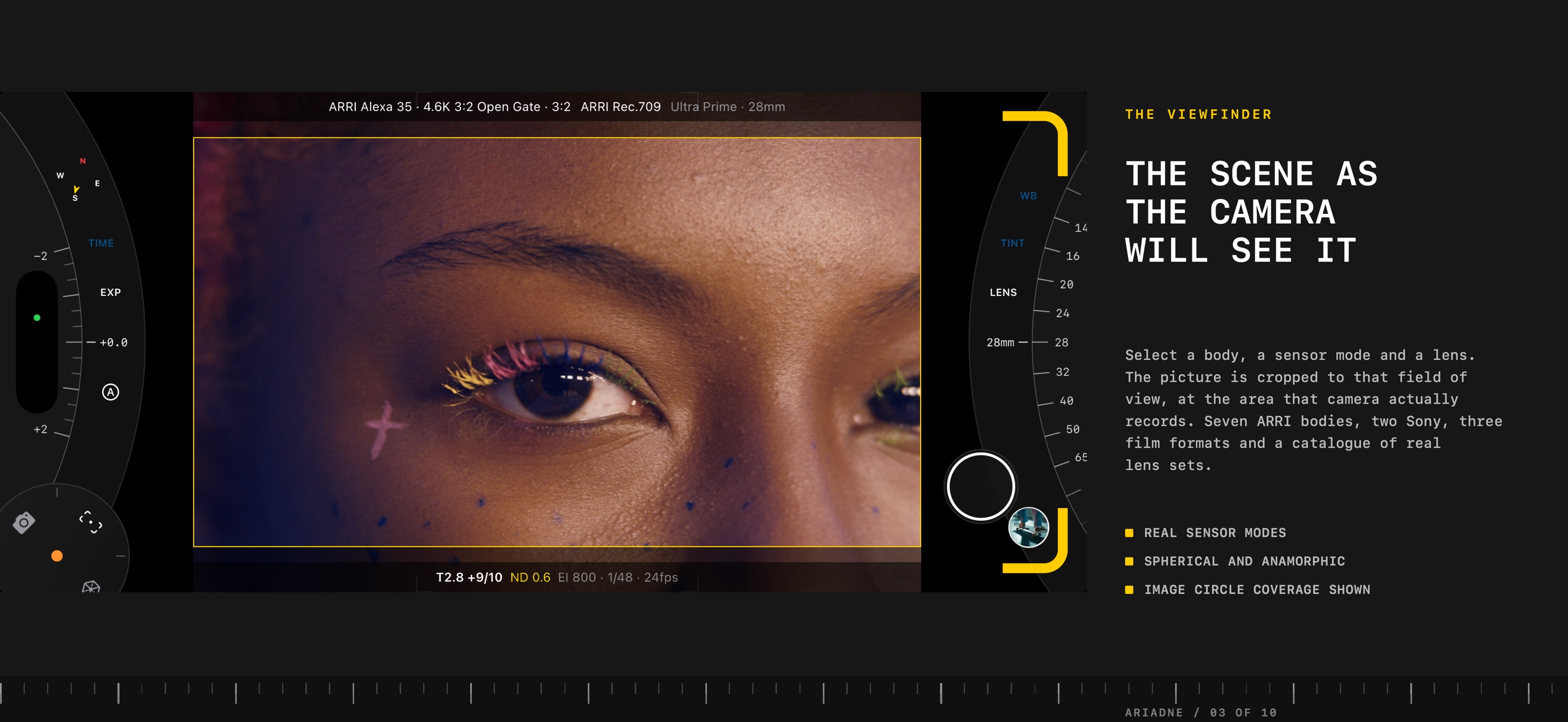
The viewfinder is the one the trade knows. The operator selects a body from seven ARRI models, two Sony Venice models and three film formats, a sensor mode at its real recorded area and aspect ratio, and a lens from a searchable catalogue of real sets, spherical and anamorphic, and the picture is cropped to that field of view. Where a lens set carries image circle data, Ariadne states whether it covers the sensor; where there is no published figure, nothing is drawn.
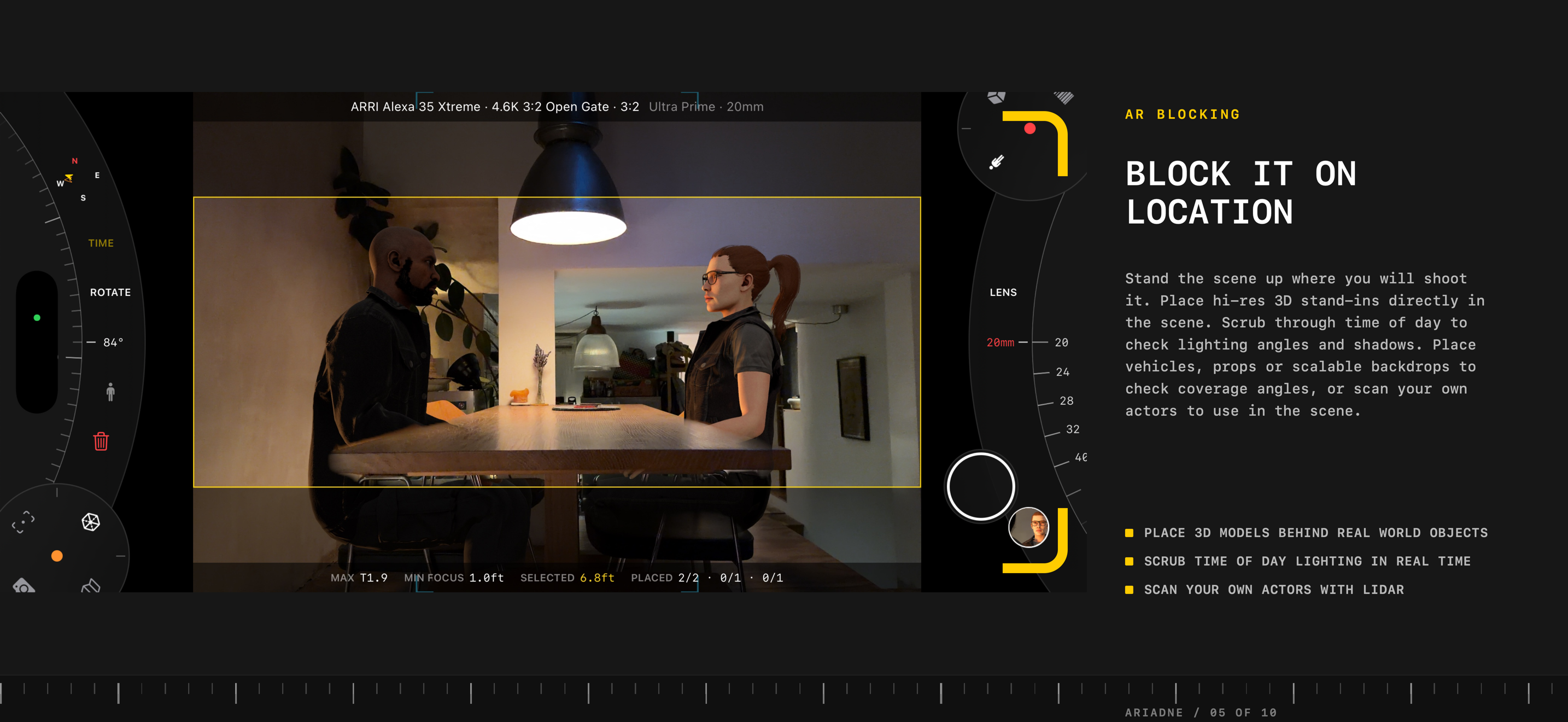
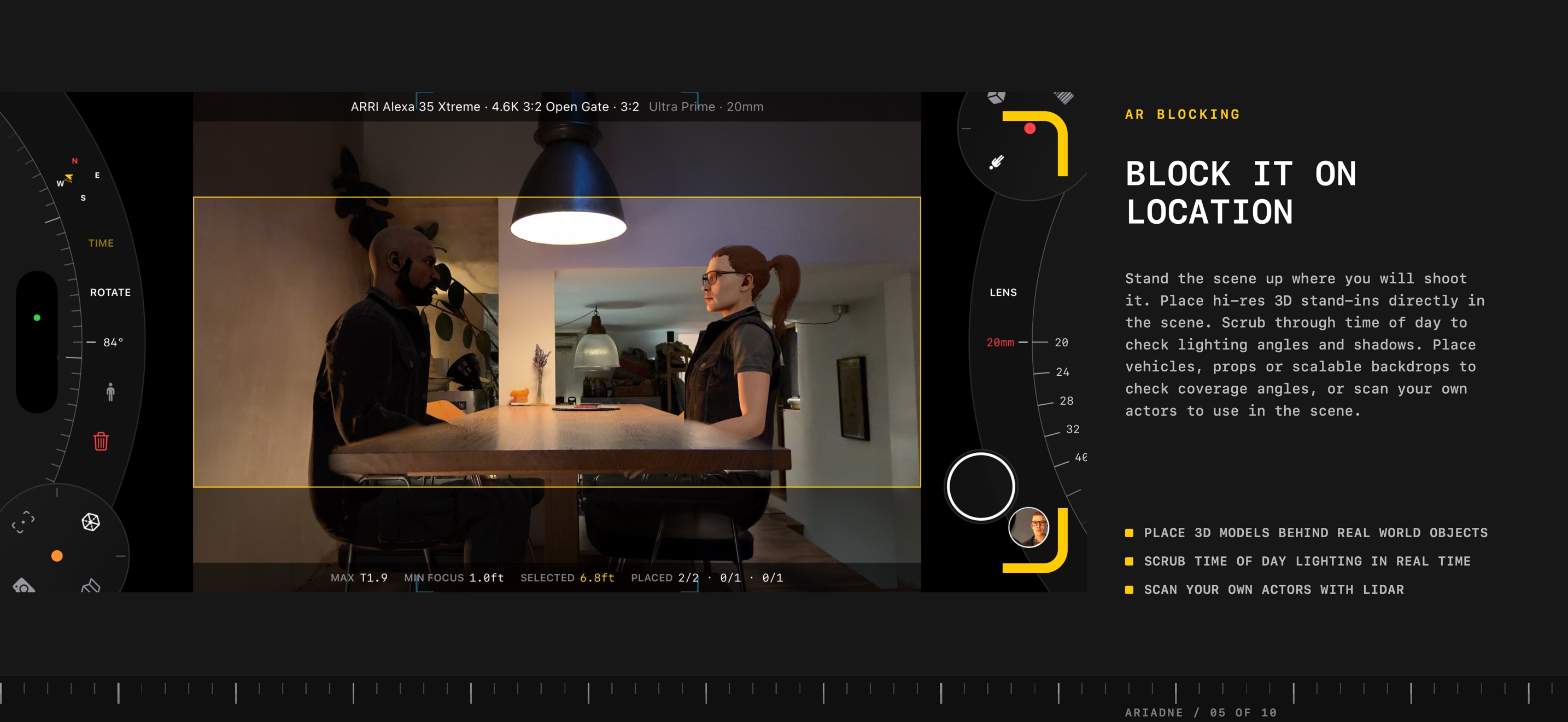
Ariadne also blocks the scene in AR. Here, high-resolution, lighting-grade stand-ins are placed at true height on the real floor, seen through the selected lens and occluded by the real foreground, with backings dressed from the photo library, vehicles, interior cutaways, tables and seating. A production's own actor can be scanned with LiDAR and placed as a double.
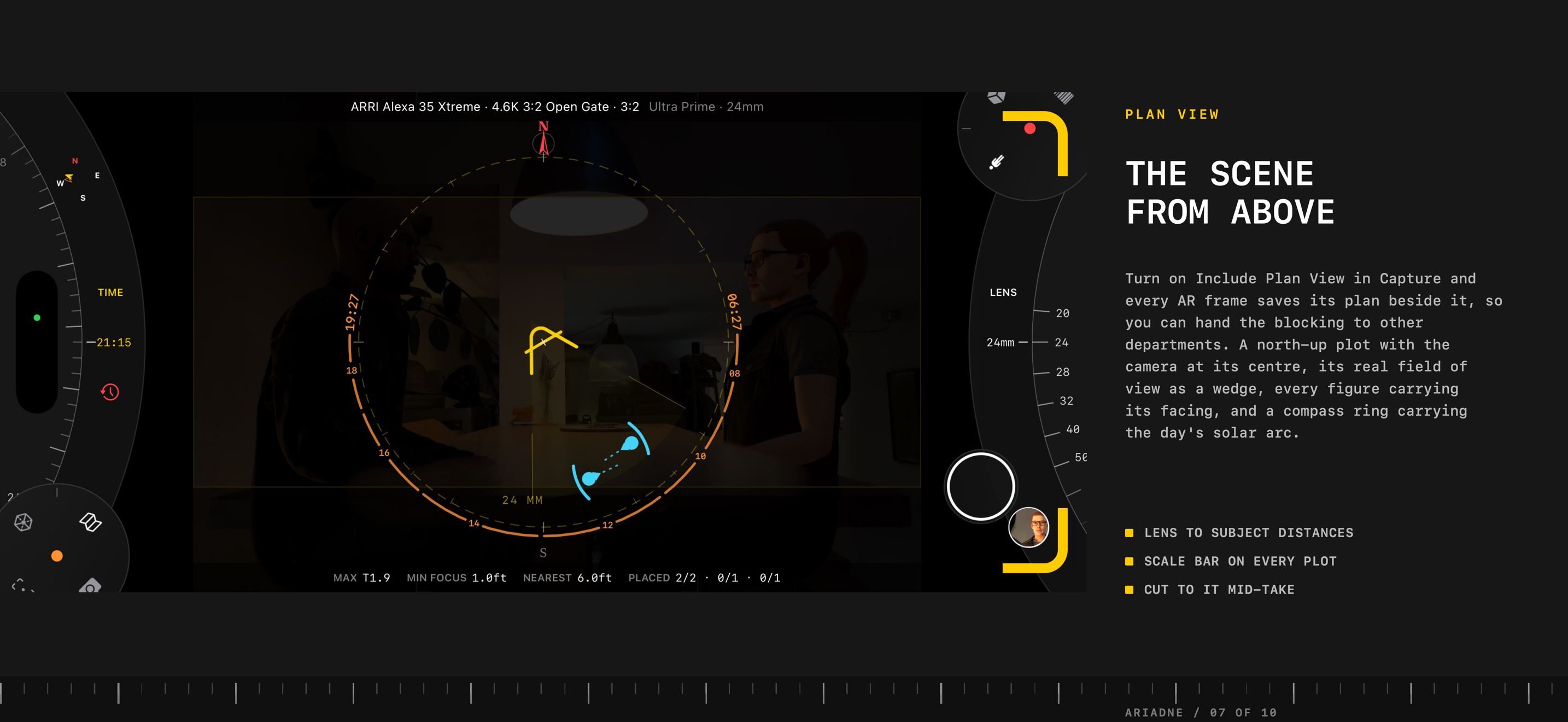
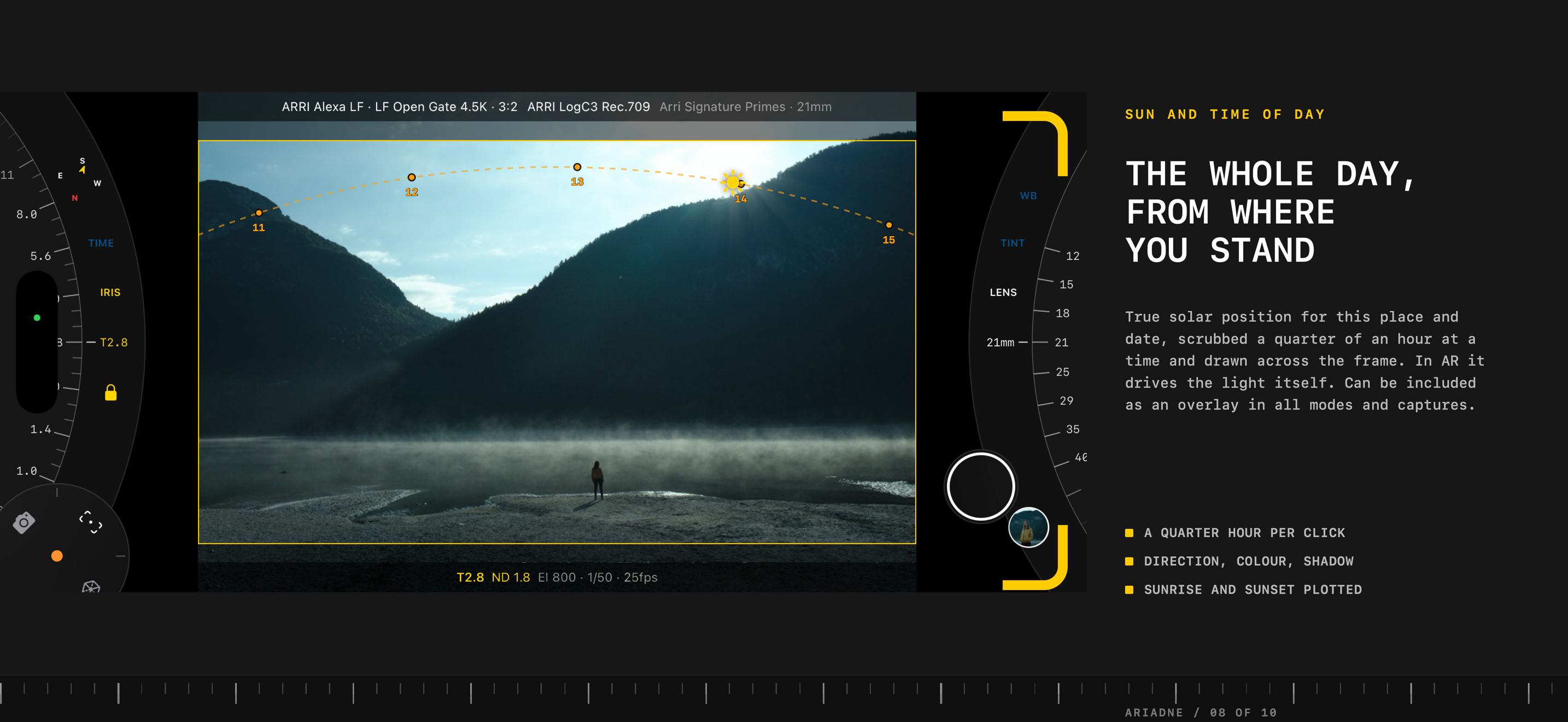
The sun is scrubbed through the day a quarter of an hour at a time and drawn across the frame, and in AR it drives the direction, colour temperature and shadows of the scene lighting. A top-down Plan View plots the camera, its real field of view, every figure with its facing and the day's solar arc; saved beside the photograph it adds a scale bar and lens to subject distances, to hand the blocking to other departments. All of it is built to be fast enough for a scout or a shooting day: just enough, quickly, rather than a full previsualisation tool.
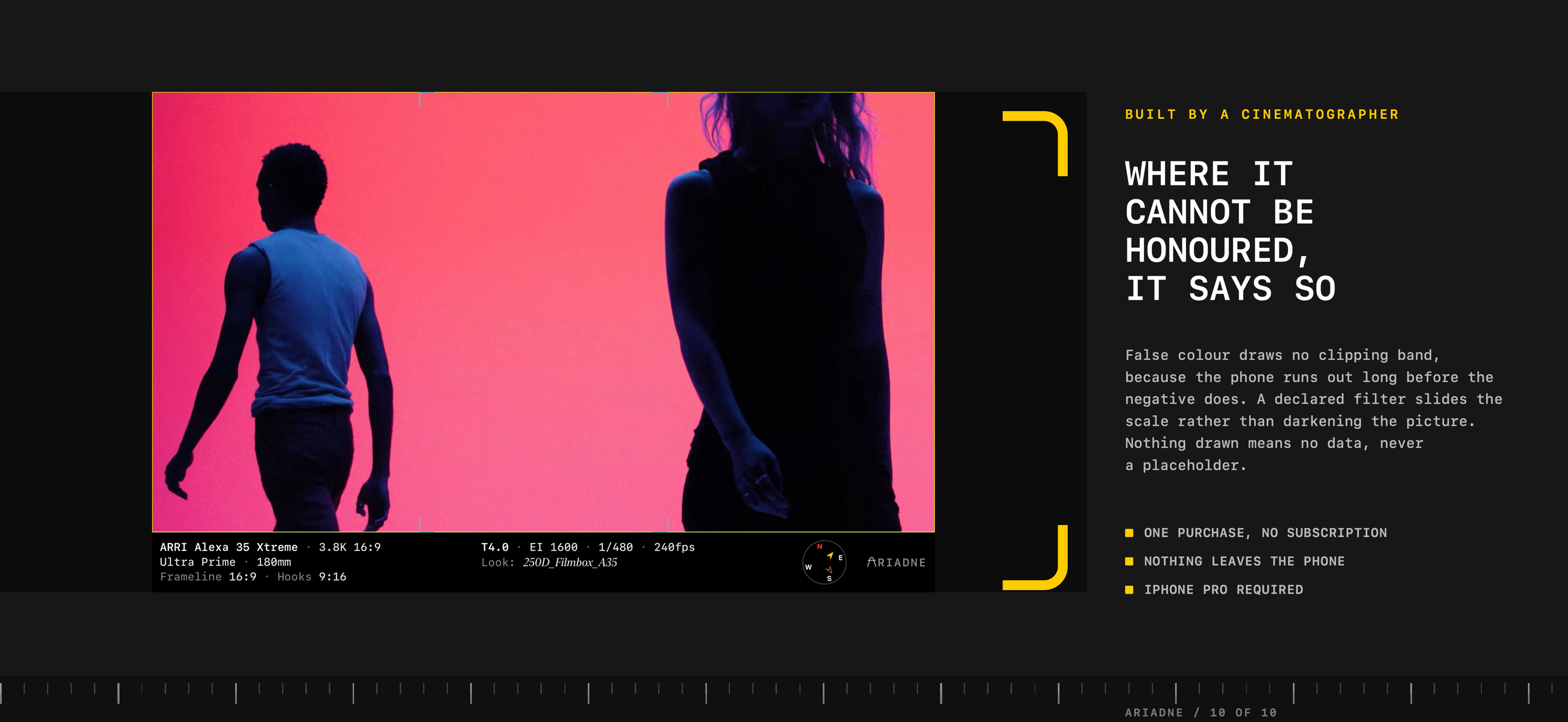
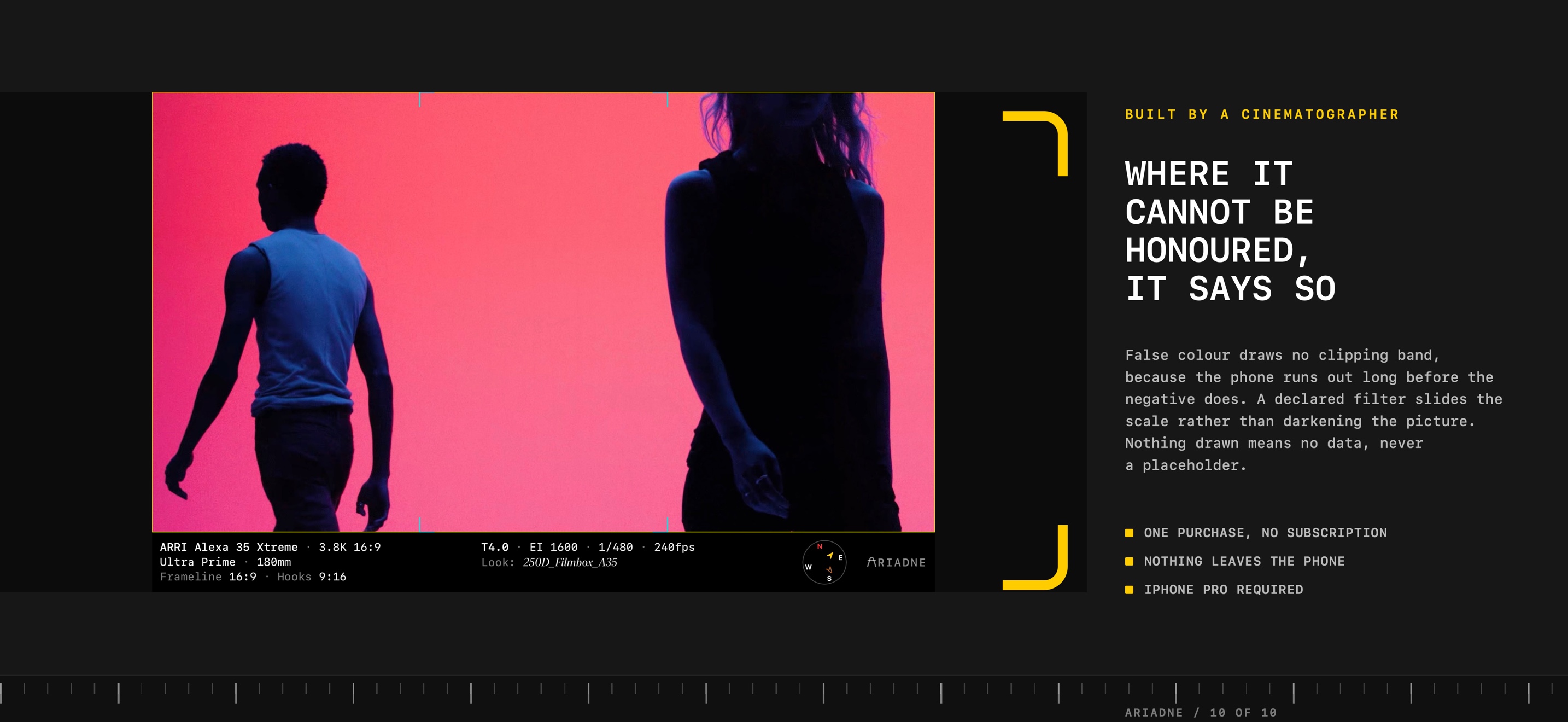
Some things Ariadne does not do, on purpose. A declared filter does not darken the picture; it slides the marked scale, which is what a filter does to the stop you set. A digital body re-rated is a declaration, and the stop follows it. A film stock re-rated is a decision to expose the negative away from its box speed, so the stop moves and the picture, rendered at box speed, stays put; Ariadne says so rather than quietly moving the picture to match. A spot meter was built and then removed, because too much of a scene read as uncertain for it to be relied on. Where there is no data, nothing is drawn; there are no placeholders. Each handset can measure the true field of view of its own cameras and match them to one another against a grey card, so the framing and the stop are measured on that phone rather than taken from a specification.
"Every figure it shows is one I would stand behind on set," said Jake Scott, the cinematographer who built it. "Where the phone cannot give an honest reading, it says so and gives the reason."
- Light meter that holds to about a third of a stop against an incident meter, with ND declaration and a recommended filter to reach the lens's widest mark
- Held exposure: the control wheel becomes an iris ring in T-stops that re-exposes the sensor
- False colour in stops from mid grey, reading the selected film stock at box speed, with no over-exposure band by design
- Apple Log pipeline with .cube, .alf4 and .aml import, each look shown with its response curve and where 18% grey lands
- Eight film stock emulations from the manufacturers' published data
- Per-handset calibration of camera field of view and metering against a grey card
- Director's viewfinder across seven ARRI bodies, two Sony Venice bodies and 35mm, 16mm and 65mm film, at real sensor modes and recorded areas
- Searchable catalogue of real lens sets, spherical and anamorphic, with image circle coverage resolved against the selected sensor, and 1.4x and 2x adapters
- AR blocking with lighting-grade stand-ins, props, vehicles and dressed backings, plus LiDAR scanning of a production's own actor
- True solar position driving both the on-screen sun path and the AR scene lighting
- Plan View with field of view wedge, facings, solar arc, scale bar and subject distances
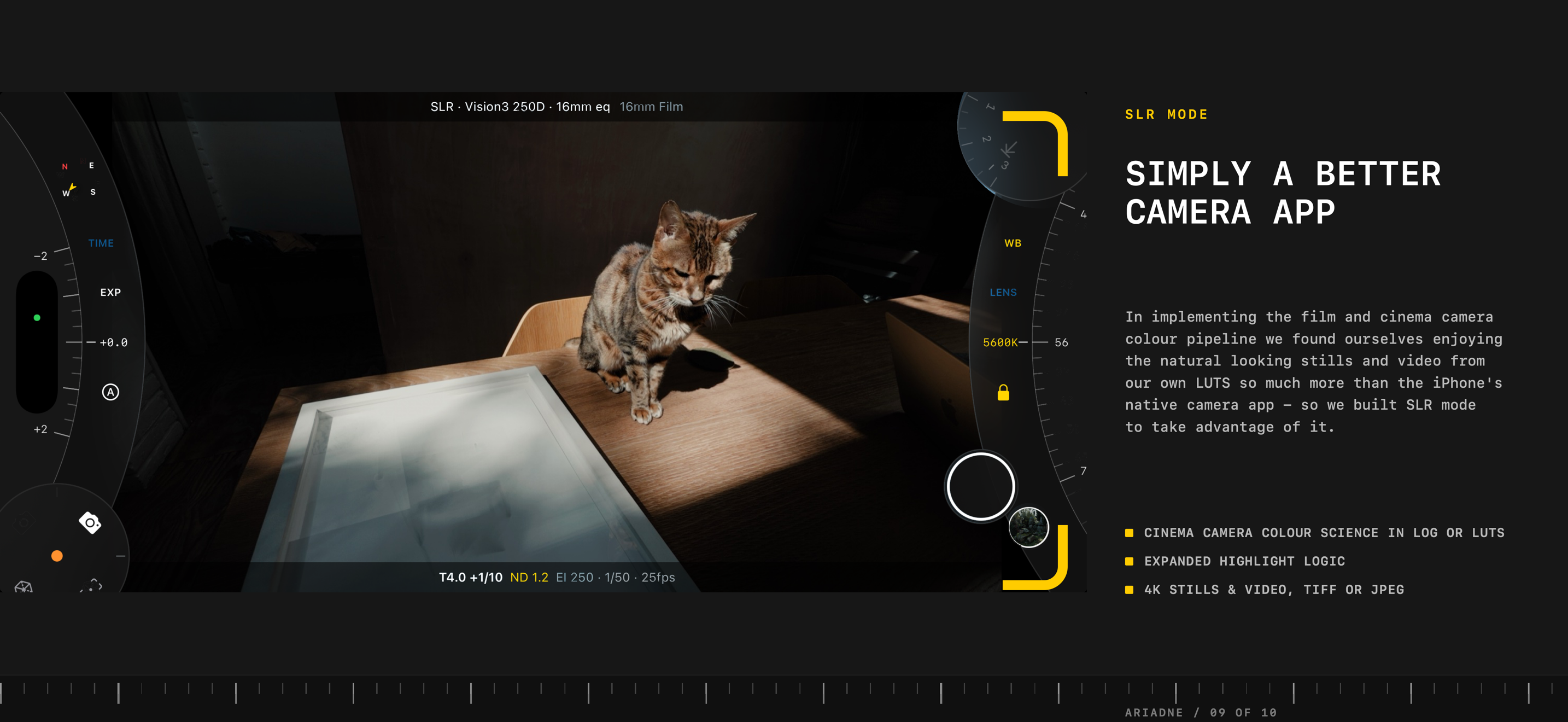
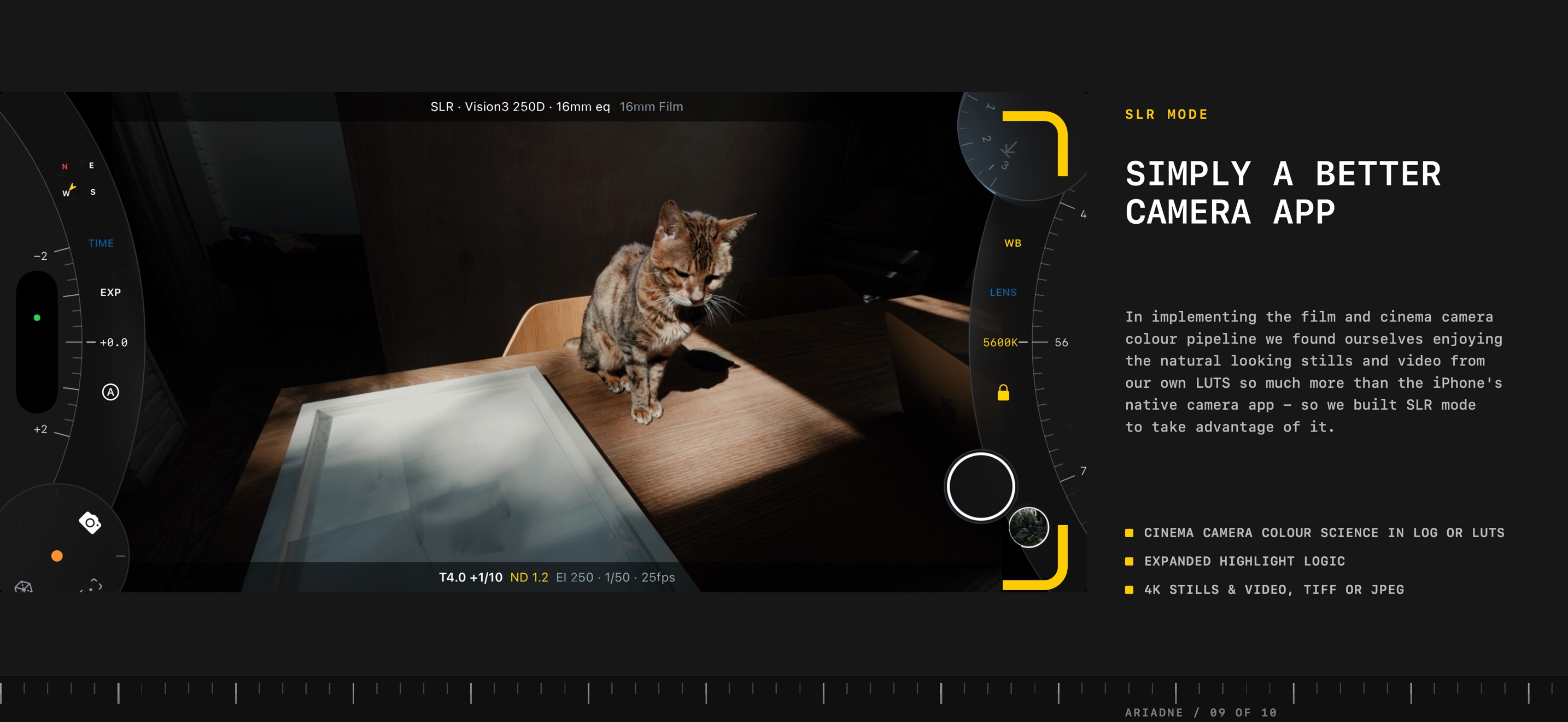
- SLR Mode: the same colour pipeline as a stills and video camera
- Stills and takes with framelines, hooks, compass and exposure burnt in, and a JSON sidecar
Ariadne is available now on the App Store at £99.99 and $99.99, a single purchase with no subscription, no in-app purchases and no account. It requires an iPhone Pro, for the LiDAR sensor and the three rear cameras. The light meter, false colour, the Looks and the film stocks run on Apple Log and need an iPhone 15 Pro or later. The download is 3.3 GB. Nothing captured in the application leaves the phone.
Ten App Store plates, 2868 x 1320. Each links to the PNG; the JPEG carries 300 dpi for print. Clean captures without the plate text are available on request.

| App | Ariadne—Cinematography Tools |
|---|---|
| App Store | https://apps.apple.com/app/id6803721990 |
| Developer | Jake Scott Studio Limited, 27 Mortimer Street, London W1T 3BL |
| Platform | iPhone Pro, iOS 27 or later |
| Apple Log | needed by the light meter, false colour, the Looks and the film stocks (iPhone 15 Pro or later) |
| LiDAR | needed by AR blocking and actor scanning (every iPhone Pro) |
| Price | £99.99 / $99.99, one purchase, no subscription, no in-app purchases |
| Size | 3.3 GB |
| Category | Photo & Video |
| Release date | September 2026 |
| Web | jakescottstudio.com |
| Support | jakescottstudio.com/support |
| Privacy | jakescottstudio.com/privacy |
| Images | Jake Scott Studio, free for editorial use with coverage of Ariadne |
Jake Scott Studio Limited is the practice of Jake Scott, a working cinematographer based in London. Ariadne is its first release.